



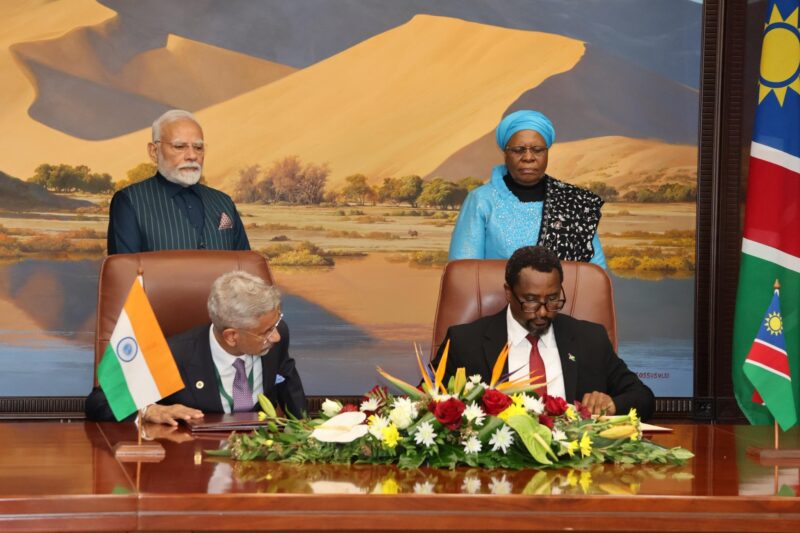
Last week in Windhoek, history quietly repeated itself.
For the first time since 1998, an Indian Prime Minister touched down on Namibian soil. Speeches were made, cameras flashed, minerals discussed. But one line in the official communique carried far more weight than most noticed:
“We will cooperate on digital technology, including digital payments.”
It sounds simple. But in a country where most people still use cash and mobile money is patchy at best, that single phrase could reshape how Namibians pay, get paid, and build wealth in the next decade.
India is not just sharing tech — it’s sharing power. The soft kind. The kind that rewires back-end systems, reframes who controls platforms, and redefines sovereignty in the age of digital finance.
So what exactly is India offering? Why now? And how can Namibia embrace the opportunity — without handing over the steering wheel?
India’s Digital Diplomacy Isn’t Talk — It’s Code
India isn’t just a tech giant — it’s the world’s biggest open-source welfare machine.
It has spent the last decade building a powerful, state-backed digital stack known globally as India Stack. It includes:
- Aadhaar – biometric ID for over 1.3 billion citizens
- UPI (Unified Payments Interface) – real-time, free digital payments used by over 350 million people
- DigiLocker – digital document storage tied to your ID
- eKYC, eSign, eHealth, AI in agriculture — all running on open APIs
And here’s the twist: India is exporting all of this — for free — as digital public infrastructure (DPI) to countries in Africa, Asia, and Latin America.
Why? Because whoever supplies the rails of digital life also shapes the rules.
It’s diplomacy via source code. Soft power in the age of servers.
And Namibia is next in line.
Why This Matters to Namibia Right Now
Namibia is under pressure to modernise — fast. Our digital transformation strategy looks good on paper, but on the ground:
- Only 55% of adults are financially included
- Cash is still dominant, especially outside Windhoek and Walvis Bay
- Mobile money is fragmented, with no unified payment system
- Youth unemployment is over 40%, yet tech skills remain underfunded
- Government systems lag behind; most services aren’t digitised or mobile-ready
India’s offer comes at a moment of need. And it’s not abstract. Digital payments are a real, scalable solution to:
- Boost financial inclusion for rural and informal workers
- Help SMEs accept money digitally without expensive infrastructure
- Enable government grants, pensions, and youth funds to flow directly
- Cut corruption, increase speed, and reduce transaction costs
- Open new doors for fintech startups and cross-border trade
But here’s the thing: if we import the system without shaping it, we may solve one problem and create five new ones.
The Real Question: Who Will Own the Back-end?
Let’s be blunt: code has politics. And back-end control is where the real power sits.
If India helps us launch a UPI-style system — but retains hosting, updates, or integration rights — we’ll be tapping to pay on rails we don’t control.
That opens the door to:
- Data privacy risks if user info flows outside Namibia
- Vendor lock-in where only Indian contractors can maintain or scale the system
- Exclusion of Namibian fintechs from the national stack
- A future where Namibians are users, not builders
This is not about rejecting India’s help — it’s about owning what we adopt.
From Minerals to Megabytes: A Strategic Pivot
India is already one of Namibia’s top three Asian trade partners and a key importer of uranium.
But this new deal isn’t about exports or raw materials. It’s about wiring Namibia into India’s digital model — and expanding New Delhi’s influence across the Global South.
Why?
- India wants allies in the digital space, not just buyers
- It’s positioning its open-source stack as a counterweight to China’s “smart city” surveillance exports
- Namibia, with its stability and coastal infrastructure, is a perfect pilot country for Southern African tech diplomacy
So while we focus on minerals, India is focused on megabytes.
What Namibia Must Do Now
If Namibia is serious about real digital transformation — not digital dependency — then this is the moment to act boldly.
1. Localise the Payments Stack
Any system must be hosted in-country, managed by Namibians, and adapted to our unique needs — including support for rural areas, Afrikaans/Oshiwambo interfaces, and offline modes.
2. Open It Up to Local Startups
Make the system API-accessible to fintechs like PayToday, EasyWallet, and upcoming youth-led payment apps. Build an ecosystem — not a monopoly.
3. Embed Digital Skills Development
Every rollout must come with training for Namibian engineers, not just tools for civil servants.
4. Write a Real Data Law — Fast
Without strong data protection, any system — no matter how “free” — becomes a soft invasion. Namibia must pass the draft Cybersecurity and Data Protection Bill urgently.
Global South, Local Ground
India’s rise is not colonial — but it’s strategic. It’s about influence through trust, infrastructure, and alignment. And for many African countries, that’s a welcome shift from the West’s “aid-first, ownership-later” model.
But soft power is still power. And Namibia’s job now is to localise that influence — not just host it.
This is also a chance to lead SADC by example.
If Namibia can design a transparent, secure, people-first payment system that draws on India’s experience but respects local control, we could become a regional test case for ethical digital infrastructure.
Final Thought: Swipe Carefully, Code Boldly
A handshake has happened. But handshakes aren’t strategies.
The real story starts now — in the negotiation rooms, in the developer forums, in the policies we pass (or postpone).
Namibia is no longer just choosing what tech to adopt. We’re choosing whose logic to embed — and whether we’ll be architects or renters of our digital economy.
India has shown what’s possible. Now it’s our turn to build — smartly, sovereignly, and together.
Reference Links & Further Reading