



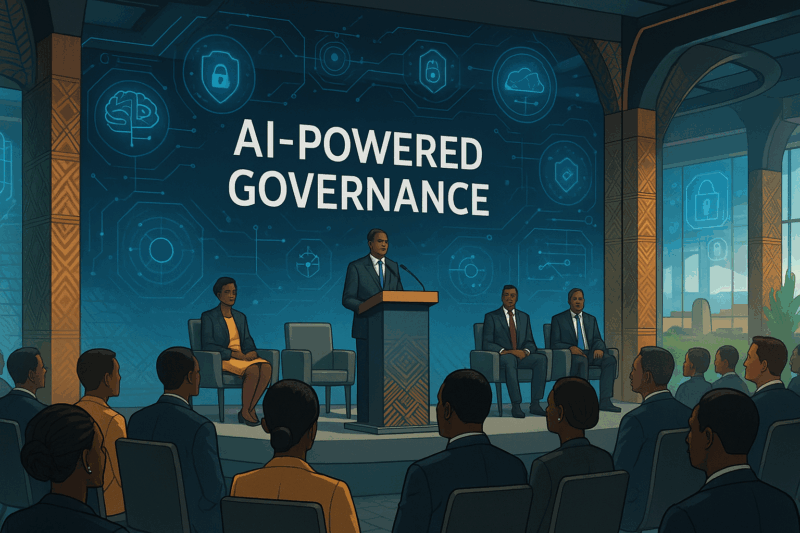
The 2025 Africa CEO Forum just wrapped up in Abidjan, Côte d’Ivoire—and while business leaders, heads of state, and tech innovators gathered to discuss everything from cross-border investments to climate resilience, one topic stood out louder than the rest: AI-powered governance.
Not in theory. In action.
Artificial intelligence has moved from Silicon Valley buzzword to a frontline governance tool across the continent—and the Forum made it clear: if African states are serious about efficient, transparent, and citizen-centered service delivery, then AI can no longer be viewed as a luxury. It’s a necessity.
And that brings us to the real question: Is Namibia ready to govern in an algorithmic age?
The Forum That Set the Tone
Held in Abidjan, the Africa CEO Forum is one of the continent’s most influential platforms for public-private dialogue. This year, it brought together over 2,000 leaders—presidents, CEOs, ministers, and tech entrepreneurs—all focused on the theme of “African Growth in the Age of Disruption.”
Panels on AI governance, digital public infrastructure, and ethical tech regulation dominated side sessions. Countries like Rwanda, Senegal, and Kenya shared how they’re already deploying AI to reform public services—from automating tax systems to streamlining digital IDs.
The message was loud and clear: Africa’s next leap won’t be physical infrastructure—it will be digital governance.
What Is AI-Powered Governance, Really?
AI-powered governance refers to using artificial intelligence to support and enhance how governments deliver services, make decisions, and respond to citizens.
That includes:
- Predictive analytics for budgeting and public health
- Chatbots handling licensing, passport renewals, or tax queries
- AI-powered fraud detection in procurement
- Digital ID systems that interact across borders
- Citizen feedback monitoring in real time using natural language processing
It’s governance, but smarter. Leaner. More responsive.
AI Is Already Reshaping African States
Rwanda is using AI to automate public services, saving millions in operational costs. Ghana is deploying it in healthcare logistics. Senegal has begun piloting smart city management tools. These aren’t abstract case studies—they are early signs of a governance revolution.
The Africa CEO Forum was clear on one point: those who ignore this shift will fall behind—both economically and diplomatically.
So, Where Does Namibia Fit In?
Let’s be honest—Namibia is not at the front of the AI race.
Yes, we’ve made some strides in ICT development, broadband expansion, and cybersecurity policy proposals. But AI governance? We’re not there yet. Our public sector still relies heavily on manual processes, legacy systems, and siloed data handling.
We don’t have a national AI strategy. Our data protection laws are still being debated. And worst of all, many of our policymakers are not even aware of how AI could be used in governance—let alone how to regulate or deploy it.
We’re already falling behind.
Why Namibia Needs to Act—Fast
AI isn’t just a technological upgrade—it’s a governance multiplier. With it, we could:
- Predict and prevent food insecurity in drought-prone regions
- Automate e-governance platforms for everything from land titles to tax filing
- Flag corruption in public procurement through anomaly detection
- Streamline border management and migration control using real-time analytics
This is not just about efficiency. It’s about accountability, accessibility, and equity in public service.
The Dangers of Delayed Action
But AI, if mishandled, also opens the door to:
- Algorithmic bias
- Unchecked surveillance
- State-sponsored misinformation
- Abuse of citizen data
This is why the Forum also stressed ethical governance frameworks, digital sovereignty, and citizen-first design. We can’t import foreign systems with zero contextual relevance. Africa must build its own AI governance models.
Namibia’s Next Moves
Here’s what we should be doing—yesterday:
- Develop a National AI Strategy
This needs to be cross-sectoral: education, health, finance, and agriculture all need a piece of the plan. - Strengthen Cybersecurity and Data Laws
You can’t have AI governance without strong digital trust. That means airtight laws and real enforcement. - Invest in AI Skills and Research
We need Namibian data scientists, not just borrowed consultants. - Digitize First, Then Automate
Many government services are still not online. We need to digitize legacy processes before layering AI on top. - Test Smart, Scale Carefully
Start small—say with customs automation at border posts—before rolling out full-scale AI-driven policy engines.
Final Thoughts: Algorithms Need Accountability
The Africa CEO Forum has done more than just raise awareness—it has issued a challenge. African nations that embrace AI for governance will not only improve public service delivery but also enhance citizen trust, boost investor confidence, and elevate their geopolitical influence.
Namibia cannot afford to be on the sidelines of this transformation.
As we dream of smart cities, regional e-commerce, and digital trade under the AfCFTA framework, we must not forget the invisible infrastructure—the governance backbone—that must power it all.
AI is that backbone.
But like any powerful tool, it must be wielded with wisdom, accountability, and context. The age of algorithmic statecraft has begun.
Let’s not miss the boat.