




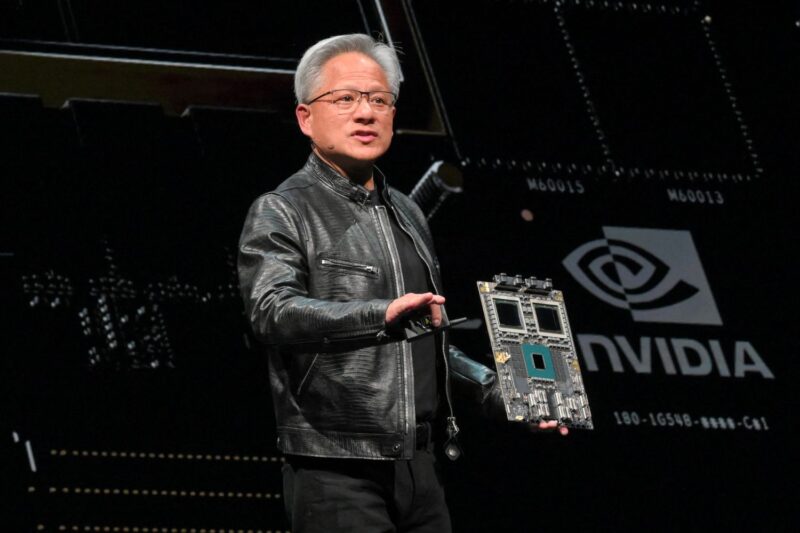
You may not know what a GPU is. You may never have seen a chip. But if you’ve ever used ChatGPT, played FIFA, opened TikTok, or edited a picture with AI filters, NVIDIA was there—in the background—making it all happen.
And now, in July 2025, that quiet force has become the most valuable company on earth.
NVIDIA is worth $4 trillion.
That’s not a typo. That’s trillion with a T.
To grasp that number: it’s more than Germany’s entire economy, more than the GDPs of all 55 African Union countries combined.
And yet, most people from Oshakati to Oranjemund still ask: “But what exactly does this company even do?”
Let’s break it down—clearly, honestly, and in context.
First Things First: What Is a Chip?
Inside every smartphone, computer, or smart TV lies a chip—a small slab of silicon etched with billions of microscopic switches. These chips are what give machines their “brains.”
There are different types. The CPU is the general manager—it tells your device what to do. But the GPU, or graphics processing unit, is the real heavy-lifter. It handles complex tasks like visual rendering, data crunching, and now—artificial intelligence.
That’s NVIDIA’s playground. They design and produce the most advanced GPUs on the planet. The type of chips that power ChatGPT, control autonomous cars, simulate climate models, and even run facial recognition systems used by security forces.
In short: NVIDIA builds the digital muscle of the 21st century.
So How Did They Get to $4 Trillion?
NVIDIA’s rise didn’t happen overnight. It began in the 1990s with gaming graphics cards. But by the 2010s, their engineers realised something game-changing—their chips could be repurposed for AI.
Suddenly, it wasn’t just gamers using NVIDIA. It was Google, Microsoft, Tesla, governments, hedge funds, and militaries. When ChatGPT launched in 2022 and AI fever swept the globe, everyone wanted NVIDIA chips—and there weren’t enough to go around.
By 2024, the world’s biggest cloud platforms were stockpiling NVIDIA’s flagship H100 chips. And in 2025, they released a new monster: the Blackwell GPU, a chip 30 times more efficient than its predecessor.
Demand exploded. Wall Street couldn’t get enough. The result? $4 trillion.
The Power Behind the Curtain
To most people in Windhoek or Lusaka, this all sounds far away. But behind almost every AI service you use—there’s an NVIDIA chip.
Ask ChatGPT a question? That response was trained on NVIDIA-powered data centers.
Watch a video that magically removes background noise? Likely used AI inference on a system built with NVIDIA’s GPU.
Use a phone that predicts your next word? You guessed it.
But it’s not just software. NVIDIA chips are inside self-driving cars, drones, military systems, factory robots, and even tools for medical research.
This isn’t just a graphics company anymore. It’s an invisible backbone of the AI age.
What Does This Mean for Namibia and SADC?
The danger for Africa is simple: we are entirely dependent on companies like NVIDIA. We don’t manufacture chips. We don’t own data centers at scale. And yet, our education systems, digital businesses, and even government services are increasingly running on platforms that rely on those chips.
That means when NVIDIA chips become more expensive—or are restricted by foreign policy—we feel the shock here too. If we can’t access the tools to build our own AI models or cloud platforms, we become permanent consumers in a game meant for builders.
And that’s the real issue: power in the AI era isn’t just about data—it’s about who owns the compute.
Right now, Africa owns very little of it.
The Blind Spot in Africa’s Digital Plans
Most countries in the region talk proudly about “digital transformation.” But look closer:
- We’re still debating basic broadband access.
- We haven’t secured long-term GPU access.
- We don’t fund local AI research seriously.
And the average university lab couldn’t train a decent AI model even if it had the data—because the processing power just isn’t there.
While the world is building the highways of AI, we’re still patching gravel roads with policy PDFs.
But There Is a Path Forward
Namibia is better positioned than most. We have vast solar potential—enough to power data centers sustainably. We have a growing pool of educated youth eager to learn. We are stable, connected, and geographically ideal for regional collaboration.
But to catch up, we need vision.
- We need GPU partnerships for our universities.
- We need shared AI labs that SADC members can co-develop.
- We need digital strategies that treat hardware as a national asset—not just something for the private sector to rent.
It’s time to think bigger than internet access.
We must talk about digital sovereignty—and that begins with compute power.
Final Thought: From Silicon to Sovereignty
NVIDIA’s $4 trillion valuation isn’t just about a company. It’s about control.
- Control over the chips that decide what gets built.
- Control over the data centers where our voices, photos, and ideas are processed.
- Control over who has the digital power—and who rents it.
Namibia, and Africa more broadly, can’t afford to be left out. Because in this new world, the power isn’t just in the code—it’s in the silicon beneath it.
And if we don’t own some of that silicon, we don’t own our future.
Reference & Further Reading
- NVIDIA at $4 Trillion – CNBC, July 2025
- Understanding GPUs – NVIDIA Developer Blog
- Africa’s AI Readiness – Oxford Insights 2024 Index
- Solar-Powered Data Centers in Africa – UNDP, 2023
- The New Arms Race: Chips, AI, and National Security – Brookings Institute